CHARACTER PANTHEON
Categories:
UX Design
Design Research
2026
CHARACTER PANTHEON
Categories:
Title
Title
2026
CHARACTER PANTHEON
Categories:
Title
Title
2026
about
Some characters stay with us long after the book is closed. The project began with an interest in that lingering relationship — how fictional characters can remain emotionally present, returning to us in thoughts, questions, or unfinished conversations long after their story has ended.
Character Pantheon grew from wondering what makes those connections last, and whether technology could give them more room to unfold. Developed as my Master’s graduation project at TU Delft, the project started from a broader investigation into emotional engagement in fiction reading, gradually narrowing toward the relationship between readers and characters — during reading, and beyond the final page.
credits
Design
Nam Junnan Zhang
You’re deep in the story.
Wait… who was this guy again?
Problem
Emotional engagement helps turn fiction into a personally meaningful experience, but it grows through the reader’s own relationship with the story. Design can make space for that engagement to unfold, but it cannot create it for them.
Background
Reading is beginning to move beyond static text. AI and augmentation can make the experience more adaptive, visual and conversational, responding as readers move through a story. Yet every new layer also risks interrupting the very flow it is meant to enrich.
Ambition
To explore how augmentation could support emotional engagement without taking over the reading experience — stepping in when support is useful, and stepping back when the story should lead.


Listening
Before
Building

Product Bet
Augmentation could support emotional engagement across different moments of the reading experience — not by creating the engagement itself, but by strengthening the conditions in which it can unfold, while concrete and trackable information offered a low-risk entry point for helping without taking over.
Starting with a broad brainstorm, I developed 20+ ideas into concept sketches, then clustered overlapping directions and used Concept Screening to converge on Character Pantheon.
Concept
Character
Pantheon
Character Pantheon is a character-centred reading experience built around one idea: a reader’s relationship with a character does not begin and end on a single page.
During reading, progress-aware character cards and relationship diagrams evolve with the story, gradually building a richer picture of each character and their connections while helping readers stay oriented.
Over time, these encounters accumulate into a personal Pantheon — a place to collect and revisit characters after the book is closed. From there, readers can invite selected characters into AI-supported roundtable discussions, carrying the relationship forward into reflection, interpretation and conversation.
Once the concept took shape, I designed a low-fidelity Figma prototype and tested it quickly before investing in a functional AI build.
The first validation confirmed the overall journey, while revealing that character support needed to evolve more progressively and the Dialogue needed to feel more continuous and conversational — shaping the scope and priorities of the next MVP.

Storyboard
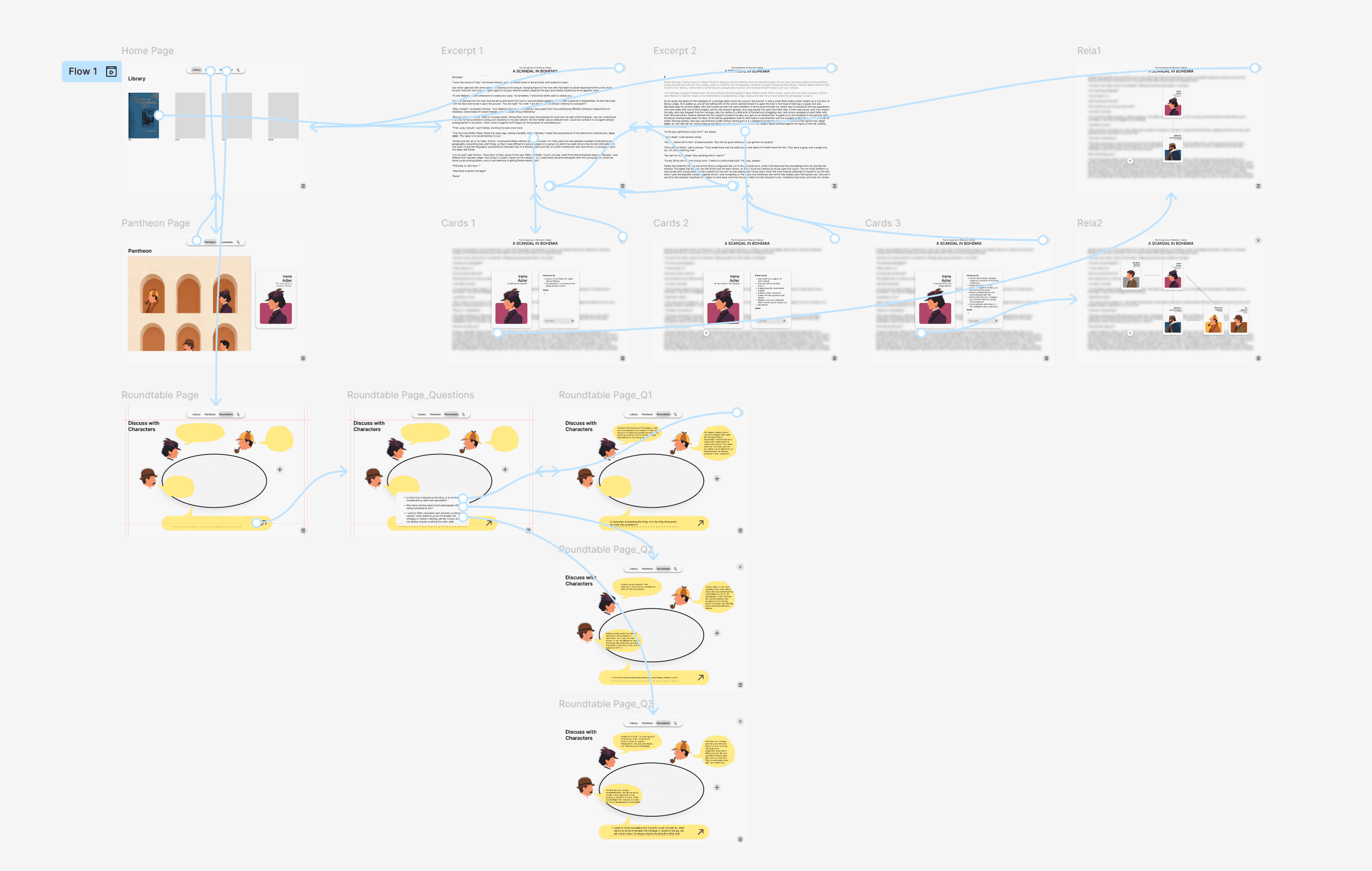
Low-fi
Figma prototype

First validation
Defining the Role of AI
Making Character Pantheon work meant deciding not only what AI could do, but where it should act, where it needed constraints, and how much control it should have within the experience.
What should be structured,
and what should be generative?

From Chatbot Turns to a Live Discussion
Characters can carry the discussion forward and respond to one another without requiring a prompt for every turn, while the reader remains free to pause, join or end the conversation.

Tuning through rapid cycles
I tuned each conversation as a whole — across prompts, character behavior, pacing and interaction.

Keep Reading Central
Reading always comes first.
Support stays out of the way of reading until the reader chooses to use it.
Character cards and relationship diagrams appear only when the reader asks for support.
During-reading support focuses on concrete, trackable story elements: who characters are,
what is known,
and how they relate.
Optional, Progress-Aware, Imagination-Preserving

As the story unfolds, character cards and relationships evolve with the reader’s progress — revealing only what the story has already made known and their own notes.
Optional, Progress-Aware, Imagination-Preserving
Character illustrations focus only on concrete story elements, staying deliberately incomplete —
enough to support recognition, while leaving the rest to the reader’s imagination.

Optional, Progress-Aware, Imagination-Preserving
Pantheon
After reading, useful support becomes something more personal: readers can collect memorable characters in their own Pantheon and return to them later.

Dialogue beyond the text
From the Pantheon, readers can invite selected characters into an AI-supported roundtable — revisiting the story or exploring questions that extend beyond it.
Results
Across the final evaluation, readers generally understood the end-to-end experience, found the character support useful and non-intrusive, and saw clear potential in extending characters beyond the book.

01
Support helped without getting in the way
Across the final evaluation, readers generally understood the end-to-end experience, found the character support useful and non-intrusive, and saw clear potential in extending characters beyond the book.
02
Different moments, one journey
Readers experienced the product as one continuous journey, carrying their connection with characters from reading support into revisiting, reflection, and dialogue after the book.
03
Balance between useful and alive
Readers strongly valued the idea of continuing with characters beyond the book, but the current dialogue did not yet live up to that promise.
The gap pointed to a deeper tension: responses that were rational, grounded and useful could start to feel too much like generic AI, while stronger emotion, disagreement and dramatic tension made characters feel more alive — even at the cost of some practicality.
Reflection
What worked well
Turning ambiguity into a clear product direction.
Research moved from a broad question around emotional engagement to a focused character-centred experience with clear intervention boundaries.
Designing AI as a system, not a feature.
Structured character data, interaction rules and grounding boundaries made the prototype more coherent and controllable.
What I’d do differently
Define the core product bet earlier.
I would narrow the MVP sooner around the few assumptions that most needed validation.
Invest earlier in character behaviour, not just dialogue generation.
Emotional contrast, disagreement and dramatic tension proved as important as grounded, useful responses.
Make trade-offs explicit before tuning solutions.
In AI experiences, usefulness can compete with character vividness, just as clarity can compete with imaginative openness.
You’re deep in the story.
Wait… who was this guy again?
Problem
Emotional engagement helps turn fiction into a personally meaningful experience, but it grows through the reader’s own relationship with the story. Design can make space for that engagement to unfold, but it cannot create it for them.
Background
Reading is beginning to move beyond static text. AI and augmentation can make the experience more adaptive, visual and conversational, responding as readers move through a story. Yet every new layer also risks interrupting the very flow it is meant to enrich.
Ambition
To explore how augmentation could support emotional engagement without taking over the reading experience — stepping in when support is useful, and stepping back when the story should lead.
Listening
Before
Building
Product Bet
Augmentation could support emotional engagement across different moments of the reading experience — not by creating the engagement itself, but by strengthening the conditions in which it can unfold, while concrete and trackable information offered a low-risk entry point for helping without taking over.
Starting with a broad brainstorm, I developed 20+ ideas into concept sketches, then clustered overlapping directions and used Concept Screening to converge on Character Pantheon.
Concept
Character
Pantheon
Character Pantheon is a character-centred reading experience built around one idea: a reader’s relationship with a character does not begin and end on a single page.
During reading, progress-aware character cards and relationship diagrams evolve with the story, gradually building a richer picture of each character and their connections while helping readers stay oriented.
Over time, these encounters accumulate into a personal Pantheon — a place to collect and revisit characters after the book is closed. From there, readers can invite selected characters into AI-supported roundtable discussions, carrying the relationship forward into reflection, interpretation and conversation.
Once the concept took shape, I designed a low-fidelity Figma prototype and tested it quickly before investing in a functional AI build.
The first validation confirmed the overall journey, while revealing that character support needed to evolve more progressively and the Dialogue needed to feel more continuous and conversational — shaping the scope and priorities of the next MVP.
Storyboard
Low-fi
Figma prototype
First validation
Defining the Role of AI
Making Character Pantheon work meant deciding not only what AI could do, but where it should act, where it needed constraints, and how much control it should have within the experience.
What should be structured,
and what should be generative?
From Chatbot Turns to a Live Discussion
Characters can carry the discussion forward and respond to one another without requiring a prompt for every turn, while the reader remains free to pause, join or end the conversation.
Tuning through rapid cycles
I tuned each conversation as a whole — across prompts, character behavior, pacing and interaction.
Keep Reading Central
Reading always comes first.
Support stays out of the way of reading until the reader chooses to use it.
Character cards and relationship diagrams appear only when the reader asks for support.
During-reading support focuses on concrete, trackable story elements: who characters are,
what is known,
and how they relate.
Optional, Progress-Aware, Imagination-Preserving
As the story unfolds, character cards and relationships evolve with the reader’s progress — revealing only what the story has already made known and their own notes.
Optional, Progress-Aware, Imagination-Preserving
Character illustrations focus only on concrete story elements, staying deliberately incomplete —
enough to support recognition, while leaving the rest to the reader’s imagination.
Optional, Progress-Aware, Imagination-Preserving
Pantheon
After reading, useful support becomes something more personal: readers can collect memorable characters in their own Pantheon and return to them later.
Dialogue beyond the text
From the Pantheon, readers can invite selected characters into an AI-supported roundtable — revisiting the story or exploring questions that extend beyond it.
Results
Across the final evaluation, readers generally understood the end-to-end experience, found the character support useful and non-intrusive, and saw clear potential in extending characters beyond the book.
01
Support helped without getting in the way
Across the final evaluation, readers generally understood the end-to-end experience, found the character support useful and non-intrusive, and saw clear potential in extending characters beyond the book.
02
Different moments, one journey
Readers experienced the product as one continuous journey, carrying their connection with characters from reading support into revisiting, reflection, and dialogue after the book.
03
Balance between useful and alive
Readers strongly valued the idea of continuing with characters beyond the book, but the current dialogue did not yet live up to that promise.
The gap pointed to a deeper tension: responses that were rational, grounded and useful could start to feel too much like generic AI, while stronger emotion, disagreement and dramatic tension made characters feel more alive — even at the cost of some practicality.
Reflection
What worked well
Turning ambiguity into a clear product direction.
Research moved from a broad question around emotional engagement to a focused character-centred experience with clear intervention boundaries.
Designing AI as a system, not a feature.
Structured character data, interaction rules and grounding boundaries made the prototype more coherent and controllable.
What I’d do differently
Define the core product bet earlier.
I would narrow the MVP sooner around the few assumptions that most needed validation.
Invest earlier in character behaviour, not just dialogue generation.
Emotional contrast, disagreement and dramatic tension proved as important as grounded, useful responses.
Make trade-offs explicit before tuning solutions.
In AI experiences, usefulness can compete with character vividness, just as clarity can compete with imaginative openness.
You’re deep in the story.
Wait… who was this guy again?
Problem
Emotional engagement helps turn fiction into a personally meaningful experience, but it grows through the reader’s own relationship with the story. Design can make space for that engagement to unfold, but it cannot create it for them.
Background
Reading is beginning to move beyond static text. AI and augmentation can make the experience more adaptive, visual and conversational, responding as readers move through a story. Yet every new layer also risks interrupting the very flow it is meant to enrich.
Ambition
To explore how augmentation could support emotional engagement without taking over the reading experience — stepping in when support is useful, and stepping back when the story should lead.
Listening
Before
Building
Product Bet
Augmentation could support emotional engagement across different moments of the reading experience — not by creating the engagement itself, but by strengthening the conditions in which it can unfold, while concrete and trackable information offered a low-risk entry point for helping without taking over.
Starting with a broad brainstorm, I developed 20+ ideas into concept sketches, then clustered overlapping directions and used Concept Screening to converge on Character Pantheon.
Concept
Character
Pantheon
Character Pantheon is a character-centred reading experience built around one idea: a reader’s relationship with a character does not begin and end on a single page.
During reading, progress-aware character cards and relationship diagrams evolve with the story, gradually building a richer picture of each character and their connections while helping readers stay oriented.
Over time, these encounters accumulate into a personal Pantheon — a place to collect and revisit characters after the book is closed. From there, readers can invite selected characters into AI-supported roundtable discussions, carrying the relationship forward into reflection, interpretation and conversation.
Once the concept took shape, I designed a low-fidelity Figma prototype and tested it quickly before investing in a functional AI build.
The first validation confirmed the overall journey, while revealing that character support needed to evolve more progressively and the Dialogue needed to feel more continuous and conversational — shaping the scope and priorities of the next MVP.
Storyboard
Low-fi
Figma prototype
First validation
Defining the Role of AI
Making Character Pantheon work meant deciding not only what AI could do, but where it should act, where it needed constraints, and how much control it should have within the experience.
What should be structured,
and what should be generative?
From Chatbot Turns to a Live Discussion
Characters can carry the discussion forward and respond to one another without requiring a prompt for every turn, while the reader remains free to pause, join or end the conversation.
Tuning through rapid cycles
I tuned each conversation as a whole — across prompts, character behavior, pacing and interaction.
Keep Reading Central
Reading always comes first.
Support stays out of the way of reading until the reader chooses to use it.
Character cards and relationship diagrams appear only when the reader asks for support.
During-reading support focuses on concrete, trackable story elements: who characters are,
what is known,
and how they relate.
Optional, Progress-Aware, Imagination-Preserving
As the story unfolds, character cards and relationships evolve with the reader’s progress — revealing only what the story has already made known and their own notes.
Optional, Progress-Aware, Imagination-Preserving
Character illustrations focus only on concrete story elements, staying deliberately incomplete —
enough to support recognition, while leaving the rest to the reader’s imagination.
Optional, Progress-Aware, Imagination-Preserving
Pantheon
After reading, useful support becomes something more personal: readers can collect memorable characters in their own Pantheon and return to them later.
Dialogue beyond the text
From the Pantheon, readers can invite selected characters into an AI-supported roundtable — revisiting the story or exploring questions that extend beyond it.
Results
Across the final evaluation, readers generally understood the end-to-end experience, found the character support useful and non-intrusive, and saw clear potential in extending characters beyond the book.
01
Support helped without getting in the way
Across the final evaluation, readers generally understood the end-to-end experience, found the character support useful and non-intrusive, and saw clear potential in extending characters beyond the book.
02
Different moments, one journey
Readers experienced the product as one continuous journey, carrying their connection with characters from reading support into revisiting, reflection, and dialogue after the book.
03
Balance between useful and alive
Readers strongly valued the idea of continuing with characters beyond the book, but the current dialogue did not yet live up to that promise.
The gap pointed to a deeper tension: responses that were rational, grounded and useful could start to feel too much like generic AI, while stronger emotion, disagreement and dramatic tension made characters feel more alive — even at the cost of some practicality.
Reflection
What worked well
Turning ambiguity into a clear product direction.
Research moved from a broad question around emotional engagement to a focused character-centred experience with clear intervention boundaries.
Designing AI as a system, not a feature.
Structured character data, interaction rules and grounding boundaries made the prototype more coherent and controllable.
What I’d do differently
Define the core product bet earlier.
I would narrow the MVP sooner around the few assumptions that most needed validation.
Invest earlier in character behaviour, not just dialogue generation.
Emotional contrast, disagreement and dramatic tension proved as important as grounded, useful responses.
Make trade-offs explicit before tuning solutions.
In AI experiences, usefulness can compete with character vividness, just as clarity can compete with imaginative openness.